
 ART
ARTKombinatić
Project Tuesday: Around the Sun – step-by-step
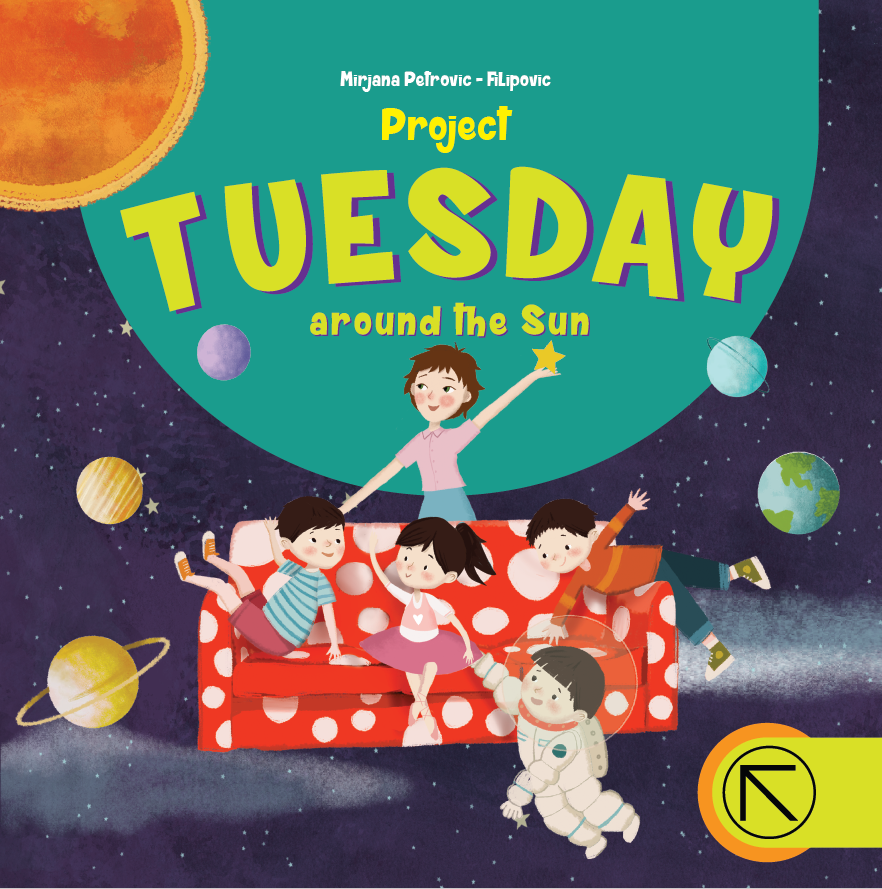
This is a detailed, step-by-step plan for the project, based on the book “Project Tuesday: Around the Sun” and all the supporting materials for students aged 6-9. This plan integrates all relevant subjects, uses the characters from the book, and provides a framework for all activities (the book and the very first pdf – retelling posters are already available at the end of the article).
Project Title: Project Tuesday: Around the Sun
Overall Concept: A cross-curricular, project-based learning journey where students follow Miss Mira and her students (Sunny, Eddie, Dylan, Ethan) on an imaginative adventure from the classroom into the solar system. The project blends storytelling, language acquisition, scientific discovery, mathematical thinking, and artistic creation.
Main Characters (to be used throughout the project):
Miss Mira: The teacher/guide.
Sunny, Eddie, Dylan, Ethan: The student protagonists (their personalities from the book can be highlighted: Eddie the astronaut, Dylan the volcano-enthusiast, Sunny the dancer, Ethan the multilingual writer).
Step-by-Step Project Plan
This project is designed to unfold over 1-2 weeks (45-minute class) or 2 whole days.
Part 1: Launch Preparations – In Our Classroom
Objective: To set the scene, introduce the story, and build foundational vocabulary and excitement.
Activities:
1. Mysterious Book Introduction:
Activity: Hold up the book “Project Tuesday: Around the Sun.” Don't read it yet. Ask predictive questions: “What do you think this story is about? Who might the characters be? Why is ‘Tuesday’ in the title?”
Materials: The book.
Additional materials: Use the “Story Retelling Posters”. Create a “Story Wall” in the classroom. Start with just the “Characters” and “Setting” posters. Before reading, have students guess who and what will be on them. After reading, fill them in together.
2. Vocabulary “Space Suit” Packing:
Activity: Introduce key vocabulary from the book and the solar system. Create a “Space Suit” on the wall for each student (a paper outline). As they learn new words (e.g., astronaut, rocket, planet, Sun, Mercury, float, erupt, skip, sphere), they write them on cards and “pack” them into their paper space suit.
Materials: The “Vocabulary” list teacher has prepared, paper, markers.
Additional materials: Use the “Space Match Flashcards”. Have students color them and use them for memory games.
3. The Shape of Space:
Activity: Introduce 2D and 3D shapes using space objects. “What shape is the Sun? (Sphere). What shape is a book from the side? (Rectangle/Cuboid). What shape are Saturn's rings? (Circle).”
Materials: 2D and 3D Shape Flashcards. Go on a “Shape Hunt” around the classroom and school, classifying objects as “Space Shapes” (sphere, circle, star, crescent) and “Earth Shapes” (square, cube, etc.).
Part 2: Blast Off! – Entering the Story
Objective: To immerse students in the narrative, work on reading comprehension, and begin the scientific inquiry.
Activities:
1. Interactive Story Reading:
Activity: Read the book aloud, dramatically. When you get to the part where “Miss M walked to her desk on her tiptoes, took Dylan’s peculiar key, unlocked the door…” physically act it out with a prop key. When they land on Mercury, pause the story.
Materials: The book, a prop key.
2. Comprehension Check-In:
Activity: Use the “Competencies Understanding.pdf” worksheet. Have students work in pairs or small groups to answer the first page about the title, author, characters, and plot.
Materials:”Competencies Understanding.pdf”.
3. Our Solar System – First Look
Activity: Using the “The Solar System Cut & Stick” and “Planet Read on” sheets, students get a hands-on introduction to the eight planets and their order. This is a fact-finding mission before their own adventure.
Materials: “The Solar System Cut & Stick.pdf”, “planet-read-and-colour.pdf”, scissors, glue, crayons.
Part 3: Planetary Explorations – Science & Math in Action
Objective: To deepen understanding of the solar system, apply knowledge of shapes, and develop critical thinking.
Activities:
1. Create a Home Planetarium:
Activity: As per your schedule, darken the classroom and use a projector to show images of constellations, the Milky Way, and planets. This brings the “walk around the Sun” to life. Use this experience for the next activities. (Another possibility is to visit a rreal planetarium).
Materials: Projector, images/software of the night sky.
2. Planet Reporters:
Activity: Assign each student or group a planet (Mercury, Venus, etc.). Using the planet flashcards and simple online resources (like the National Geographic link you provided), they must become experts and report back 2-3 cool facts. “Mercury is the fastest planet!” “Venus is super hot!”
Materials: “Space Match Flashcards.pdf”, lap tops/tablets, access to kid-friendly space websites.
3. Math Mission: Shapes in Space:
Activity: Revisit the 2D/3D shape flashcards. Now, using the planetarium and planet images, have students classify the planets and other celestial bodies. “Jupiter is a sphere. That comet's tail is an irregular shape. The rings of Saturn are a circle.”
Materials: 2D and 3D Shape Flashcards, planet images.
Part 4: Communication & Creativity – How Do We Talk in Space?
Objective: To explore non-verbal communication, creative writing, and artistic expression linked to the theme.
Activities:
1. Alien Communication Workshop:
Activity: Recap the part of the story where they try to talk to aliens. How would we communicate without words? Play games like charades with space-themed actions (e.g., “flying a rocket,” “eating space food,” “walking on the Moon”).
Materials: Charades cards you create.
2. Creative Writing:
Activity A: “Describe the Space Monster”: Use the “Describe the Monster” worksheet. Instead of a generic monster, it's an alien they met on their journey. Encourage them to use the vocabulary they've learned.
Activity B: “What would I take to Space?”: Use the “10 Things I Would Take to Space” rocket writing frame. This encourages personal connection and practical thinking.
Activity C: “Design Your Own Planet”: Use the “Design Your Own Planet” worksheet. This is the ultimate creative task, combining art, writing, and social studies (laws, community).
Materials: describe-the-monster.pdf, what-would-i-take-to-space-rocket.pdf, design-your-own-planet.pdf.
Part 5: The Grand Finale – Building Our Solar System
Objective: To synthesize all learning into a final, collaborative project that demonstrates understanding and application.
Activities:
1. DIY Solar System Model:
Activity: As a class, build a giant, collaborative Solar System model. This can be hung from the ceiling or displayed on a large wall.
Sun: A large yellow sphere (papier-mâché on a balloon).
Planets: Use polystyrene balls of different sizes, painted according to the “Read and Colour” sheet.
Rings of Saturn: A cardboard circle with a hole in the middle.
Asteroids & Comets: Crumpled paper, foil, sticks.
Materials: Polystyrene balls, paint, string, cardboard, glue, the “Space Match Flashcards” for reference.
2. Hands-On Science & Art:
Activity A: “Textured Moon”: Follow the recipe in the “Competencies Understanding.pdf” file to create puffy paint moons. This is a direct, sensory activity from your project materials.
Activity B: “Mars Sand”: Follow the recipe to make moldable Mars sand. This connects to the scientific inquiry about soil and properties.
Materials: Ingredients for puffy paint (flour, salt, etc.), ingredients for Mars sand (sand, cornstarch, etc.).
3. Project “Passport” and Celebration:
Activity: Students fill out their “Intergalactic Passport” with their picture, name, and favorite planet. Hold a “Project Tuesday” exhibition where students present their solar system model, their designed planets, and their space passports to parents or another class.
Materials: space-passport.pdf, completed artwork and models.